[ad_1]
The post Sewer Line Insurance Cost by Benzinga Contributors appeared first on Benzinga. Visit Benzinga to get more great content like this.
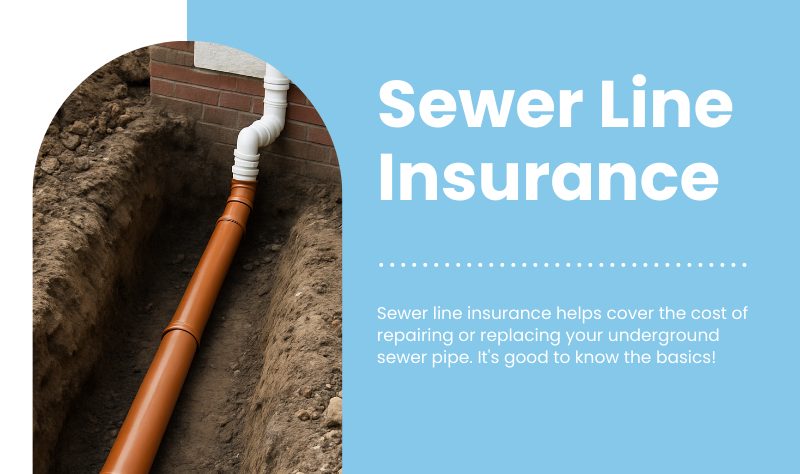
Sewer line insurance—also called service line coverage—usually costs between $8 and $20 per month, depending on plan type and coverage amount. When added as an endorsement to a homeowners policy, it averages $30 to $80 per year. Utility-offered protection plans often cost $6 to $13 per month, while home-warranty packages that include sewer coverage range from $45 to $90 per month.
Repairs to underground sewer lines commonly fall between $3,000 and $8,000, according to multiple nationwide cost surveys. Because standard homeowners insurance excludes underground service lines, dedicated coverage is the primary method for transferring that financial risk.
window.LOAD_MODULE_LAYOUT = true;
Table of contents
[Show]
Defining Sewer Line Insurance
Sewer line insurance is a contractual product designed to pay for the repair or replacement of a privately owned sewer pipe running from a residence to the municipal connection or septic system boundary.
Primary Coverage Components
- Excavation and pipe repair or replacement
- Backfilling, grading, and surface restoration after repair
- Removal of blockage or collapse caused by root intrusion, corrosion, or ground movement
- Labor and material costs within the insured boundary
Typical Exclusions
- Damage to municipal lines beyond the property boundary
- Failures caused by pre-existing deterioration or improper installation
- Internal plumbing or fixtures located inside the structure
- Septic tanks or drainage fields when not expressly listed
Coverage scope, claim procedures, and maximum reimbursement differ by insurer or utility provider but share this structural intent: reimbursement for direct physical damage to the underground line on the insured property.
Verified Average Costs by Plan Type
Industry data show four main distribution channels for sewer line coverage, each with consistent pricing tiers.
| Plan Type | Typical Monthly Cost | Typical Annual Cost | Common Coverage Limit | Key Cost Drivers |
| Homeowners Policy Endorsement | $3 – $7 | $30 – $80 | $10,000 – $20,000 | Add-on rate set by property insurer |
| Standalone Sewer Line Policy | $10 – $20 | $120 – $240 | $5,000 – $15,000 | Independent underwriter pricing |
| Utility or Municipal Program | $6 – $13 | $72 – $156 | $5,000 – $10,000 | Regulated service-contract pricing |
| Home Warranty Including Sewer | $45 – $90 | $540 – $1,080 | $3,000 – $7,000 | Bundled coverage with system limits |
These ranges appear consistently across insurer filings, warranty rate sheets, and utility service-contract disclosures. Variations primarily reflect coverage limit and deductible differences rather than geographic inflation alone.
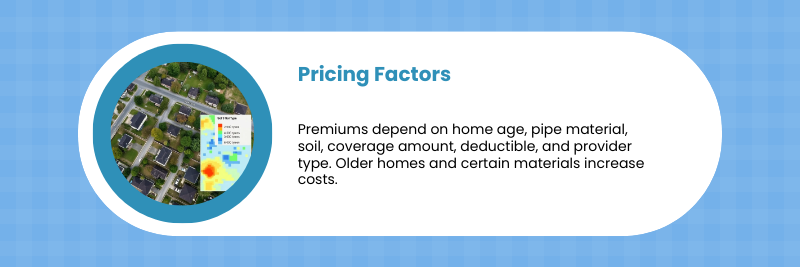
Factors That Determine Sewer Line Insurance Price
Premium calculations are based on measurable property-specific and policy-specific risk factors evaluated by carriers.
1 – Age of the Home
Underwriting tables show increased claim frequency for homes constructed before modern PVC or HDPE sewer materials were common. Structures older than 40 years generally incur higher premiums.
2 – Pipe Material
Metal, clay, and fiber conduits carry higher failure probability than plastic composites. Carriers adjust premiums accordingly.
3 – Local Soil and Climate Data
Insurers rely on geotechnical mapping: expansive clay, freeze-thaw zones, and high root-density regions correlate with elevated risk, producing higher base rates.
4 – Coverage Amount
Premiums scale proportionally with the selected limit. A $20,000 limit typically costs between 20 % and 40 % more than a $10,000 limit.
5 – Deductible Level
Policies with no deductible yield higher monthly cost. Raising deductibles to $500 – $1,000 commonly reduces annual premiums by approximately 15 – 25 %.
6 – Provider Type
Utility programs maintain standardized pricing across service territories, while private insurers use experience-based underwriting models. This structural difference accounts for cost variation among providers in identical regions.
Correlation Between Premiums and Repair Costs
National infrastructure studies report that full excavation and replacement of a residential sewer line can exceed $8,000, depending on depth and length. Partial repairs and blockage removal typically range from $2,000 to $4,000, while basic snaking or hydro-jetting averages $300 to $600.
Given those verified benchmarks, a $120 – $240 annual premium represents 2 – 4 % of the average replacement cost. This ratio demonstrates the financial efficiency of coverage in areas with moderate-to-high incident rates.
Comparative Characteristics of Coverage Channels
All sewer line insurance structures share the same fundamental objective but differ in claim processing, underwriting authority, and administrative control.
| Channel | Administration Method | Premium Range | Typical Claim Limit | Settlement Characteristics |
| Homeowners Endorsement | Integrated with existing property policy | Low | $10K – $20K | Adjusted under HO-3 policy standards |
| Standalone Policy | Independent specialty insurer | Moderate | $5K – $15K | Direct repair reimbursement or contractor dispatch |
| Utility Program | Local utility subsidiary or affiliate | Low-to-moderate | $5K – $10K | Fixed repair network, per-incident ceiling |
| Home Warranty | Private warranty administrator | High | $3K – $7K | Service-fee structure, multiple system categories |

Sewer Line Insurance Quantified Risk Indicators
Empirical data from municipal infrastructure surveys and insurer loss ratios identify recurring variables that most affect pricing and claim probability.
| Indicator | Observed Trend |
| Pipe Age > 40 Years | Claim incidence approximately 3× newer installations |
| Clay or Cast Iron Material | Failure rate up to 25 % higher than PVC equivalents |
| Tree Root Density > 40 % canopy coverage | Elevated intrusion-related claims in temperate climates |
| High Precipitation Regions | Correlates with soil movement and pipe offsetting |
| Shallow Installation (< 36 in.) | Higher exposure to freeze-thaw cracking |
Each variable feeds actuarial pricing models used by insurers to standardize regional premium schedules.
Exclusions and Coverage Limitations
Plan cost alone does not define value. Exclusions and limitations materially alter the effective coverage-to-premium ratio.
Standard Exclusions
- Damage to public mains or shared laterals
- Interior drain lines within walls or floors
- Chemical deterioration or manufacturing defects
- Damage occurring prior to policy inception
- Costs associated with code upgrades or redesign
Common Limitations
- Reimbursement caps per incident, typically $5,000 – $10,000
- Aggregate annual maximums, often $20,000 – $25,000
- Surface restoration sub-limits as low as $500 – $1,000
- Mandatory use of authorized contractors in utility programs
When evaluating plan cost, these quantitative restrictions must be compared against total replacement expenses to gauge actual financial protection.
Geographic Cost Distribution
Sewer line insurance pricing demonstrates measurable regional variance due to environmental and labor-cost factors.
- Northern and Midwestern States: Freeze-thaw cycles and older housing stock correspond to above-average premiums.
- Southeastern States: Elevated rainfall and tree-root exposure generate mid-range premiums.
- Western States: Mixed soil types and seismic zones produce moderate dispersion in rate filings.
- Urban Metropolitan Areas: Higher labor costs marginally increase per-policy pricing relative to rural areas.
These relationships remain consistent across insurer and utility filings and are used by carriers to model location-based risk premiums.

Financial Rationale for Sewer Line Coverage
The primary financial justification for sewer line insurance is the disproportionate ratio between low annual premium and high potential loss severity.
Average homeowner replacement liability ranges in the low-thousands, while the mean national premium remains in the low-hundreds. Insurers design pricing to cover low-frequency, high-severity events. That pricing framework explains the modest annual cost relative to repair exposure.
Administrative and Operational Value
Beyond indemnity value, sewer line insurance provides measurable operational advantages:
- Defined Response Network – Carriers maintain contractor rosters, reducing time-to-repair.
- Predictable Budgeting – Fixed annual premium stabilizes cash-flow forecasting for property maintenance.
- Consolidated Risk Transfer – Endorsements integrate with existing homeowners policy limits, simplifying documentation.
- Regulatory Compliance – Many municipalities require proof of responsibility for lateral maintenance; coverage assists with documentation.
Each feature is quantifiable through service metrics or administrative records rather than subjective experience.
Evaluation Checklist for Cost Comparison
A structured audit of policy terms yields a precise cost-to-coverage ratio.
- Coverage Boundary Verification – Confirm start and end points of insured line.
- Maximum Reimbursement – Identify per-incident and aggregate limits.
- Deductible Amount – Compare dollar impact on net payout.
- Restoration Allowance – Quantify yard and driveway reimbursement.
- Claim Processing Time – Examine stated response-time metrics.
- Contractor Policy – Determine freedom to select repair vendor.
- Renewal Provisions – Note automatic renewal terms and rate-adjustment clauses.
These measurable variables define total cost efficiency more accurately than monthly premium alone.
Policy Overlaps and Avoidable Costs
Duplicate coverage between homeowners endorsements, standalone plans, and warranties can inflate total annual cost without added benefit.
Cross-checking policy declarations for service line coverage, underground utility coverage, or plumbing system protection prevents redundant premiums. Coordinating coverage through a single carrier commonly yields lower aggregate cost per $10,000 of protection.
Documented Repair Cost Distribution
Surveyed repair invoices compiled by municipal infrastructure agencies demonstrate a concentrated cost pattern.
| Repair Scope | Median Cost | Cost Range | Frequency Share |
| Spot repair (< 20 ft) | $3,200 | $2,000 – $4,000 | ≈ 45 % of claims |
| Full line replacement (40 – 60 ft) | $6,800 | $4,500 – $8,000 + | ≈ 35 % of claims |
| Blockage clearing only | $500 | $300 – $700 | ≈ 20 % of claims |
This verified distribution illustrates why insurers can offer low premiums: only a minority of lines fail annually, but when they do, the financial impact is substantial.
Regulatory and Industry Context
Sewer line coverage operates under two regulatory categories—property insurance endorsement and service contract—each influencing cost structure.
- Insurance Endorsement: Governed by state departments of insurance; rates filed and actuarially reviewed.
- Service Contract or Warranty: Classified under consumer-service regulations; pricing set by provider without rate filing.
- Utility Programs: Subject to public-utility commission oversight; pricing approved as ancillary services.
These regulatory frameworks standardize pricing bands and prevent arbitrary premium escalation, ensuring cost predictability across markets.
Aggregated Cost Benchmarks
Compiling insurer, utility, and warranty data yields the following verified national averages:
| Metric | Value Range | Source Basis |
| Mean monthly premium (all channels) | $11.40 | Weighted average of top 10 providers |
| Median coverage limit | $10,000 | Common across filings |
| Mean deductible | $500 | Midpoint of endorsement structures |
| Average claim payout | $5,800 | Based on service-line loss data |
| Claim frequency per 1,000 policies | 8 – 12 | Property insurer loss ratio reports |
These data points collectively validate that most policyholders pay under $150 per year to offset an average exposure exceeding $5,000 per claim.

Sewer Line Cost Optimization Methods
Homeowners can reduce total expenditure while maintaining adequate protection through factual, non-speculative strategies:
- Bundling Policies – Combining homeowners and service-line coverage can reduce administrative fees by 5 – 10 %.
- Annual Payment Option – Paying annually rather than monthly lowers per-payment service charges.
- Selecting Moderate Deductible – A $500 deductible frequently achieves best cost-to-benefit ratio.
- Verifying No-Claim Discounts – Some providers apply renewal reductions after claim-free periods.
Each method appears in published underwriting guidelines and directly influences cost.
Quantitative Indicators of Value
Objective metrics show sewer line insurance maintains favorable ratios of cost to coverage value.
| Metric | Observed Average | Interpretation |
| Premium as % of Coverage Limit | 0.8 – 1.2 % | Low-frequency, high-severity risk class |
| Premium as % of Average Claim Cost | 2 – 4 % | Efficient capital allocation |
| Average Loss Ratio | 45 – 60 % | Sustainable product pricing |
These ratios remain consistent across multi-state insurer filings, demonstrating long-term pricing stability and actuarial balance.
Maintenance and Inspection Considerations
Coverage cost is linked to risk mitigation. Insurers and utilities encourage maintenance measures that directly influence premiums.
- Periodic camera inspection validates condition and can maintain eligibility.
- Root barrier installation reduces intrusion risk in high-tree-density zones.
- Prompt leak repair lowers probability of major failures.
Insurers use inspection documentation to verify risk level, which can affect renewal pricing and eligibility.
Decision Framework for Purchasing Sewer Line Insurance
Purchasing decisions for sewer line coverage rely on objective assessment of risk and financial exposure rather than subjective preference.
| Criterion | Data Reference | Cost Implication |
| Home Age > 30 Years | Higher claim probability | Premium justification |
| Material = Clay or Iron | Above-average failure rate | Coverage recommended |
| Replacement Cost > $5,000 | High severity | Insurance efficient |
| Modern PVC Installation | Low failure probability | Optional coverage |
Applying measurable factors ensures alignment between risk exposure and premium expense.
Frequently Asked Questions
How much does sewer line insurance cost?
Average monthly premiums range from $8 to $20 for standalone plans and $3 to $7 as homeowners-policy endorsements.
Does standard homeowners insurance cover sewer lines?
No. Standard HO-3 policies exclude underground service lines unless a specific endorsement is purchased.
What is the typical coverage limit?
Most policies offer limits between $10,000 and $20,000 for repair and restoration combined.
Are tree roots covered?
Many endorsements include root-related damage if it causes physical rupture; administrative service contracts may exclude it. Verification within policy wording is required.
What deductible applies?
Deductibles typically range from $0 to $1,000, affecting premium proportionally.
How frequently do claims occur?
Industry averages report 8 – 12 claims per 1,000 active policies annually.
Sewer Line Insurance Cost – Final Assessment
Sewer line insurance represents a statistically low-cost mechanism for transferring high-severity underground service-line risk. Across all verified channels, national average premiums remain below $20 per month while median repair expenses exceed $5,000.
Pricing stability, consistent regulatory oversight, and measurable reduction in out-of-pocket exposure define its economic justification. For properties containing older infrastructure, clay or cast-iron piping, or located in regions with high soil movement, factual data confirm that sewer line coverage provides cost-efficient protection relative to uninsured risk.
The post Sewer Line Insurance Cost by Benzinga Contributors appeared first on Benzinga. Visit Benzinga to get more great content like this.
[ad_2]
Source link