
[ad_1]
The post HomeServe Review: Everything You Need to Know by Benzinga Sponsored appeared first on Benzinga. Visit Benzinga to get more great content like this.

Home emergencies—a burst pipe turning your basement into an indoor pool, a broken sewer line creating an unsanitary mess, or a furnace failing in the dead of winter—have a knack for striking at the most inconvenient times, transforming a peaceful evening into a frantic scramble. These unforeseen disasters not only cause immediate disruption and stress but can also lead to significant financial strain due to costly repairs.
HomeServe aims to mitigate these challenges by offering various repair protection plans. These plans are designed to absorb the shock of unexpected home system failures by handling both the logistics of repair work and the associated costs, typically in exchange for a monthly fee. The promise is simple: when a covered home emergency strikes, HomeServe steps in to manage the process, from dispatching qualified technicians to covering the repair bill, providing homeowners with peace of mind and financial predictability.
But the crucial question for any homeowner considering such a service is: does HomeServe truly deliver on its promise when you’re faced with a genuine plumbing disaster, an electrical failure that plunges your home into darkness, or a malfunctioning HVAC system? Understanding the scope of their coverage, the responsiveness of their service, and the overall value proposition is essential for determining if HomeServe is a reliable solution for safeguarding your home against the unpredictable nature of household emergencies.
What Is HomeServe & How Do Their Plans Work?
HomeServe is a company that provides home repair protection or “service plans” covering systems such as plumbing, water and sewer lines, electrical, heating, air conditioning, and appliance services.
- They often partner with utility companies or municipalities to present repair plans to homeowners.
- The model is similar to home warranties or extended service contracts: you pay a recurring premium in exchange for coverage of certain breakdowns or repairs.
- When a covered failure occurs, HomeServe dispatches a contractor, arranges the repair or replacement, and handles costs up to policy limits (excluding certain fees, deductibles, or conditions).
- Plans may vary by location, coverage type, and contractor networks.
Because these plans function as an insurance-like safety net, the devil is in the details: what’s covered, what’s excluded, how quickly repairs happen, cost caps, and the contractor quality.
HomeServe Coverage Options & Plan Structure
Not every plan is identical, but HomeServe typically splits its protection offerings into categories. Here’s what you can expect:
- Plumbing & Water / Sewer Line Plans — covers failures of pipes, underground water or sewer lines, leaks, and related repairs.
- Home System / Mechanical Plans — heating, ventilation, air conditioning, electrical system failures.
- Appliance & Equipment Plans — certain household appliances or components.
- Combination / Bundled Plans — mix of systems + plumbing + appliances.
Some key structural elements to watch:
- Service Fees / Deductibles: Many plans require you to pay a service call fee or deductible when a technician visits. In some cases, HomeServe advertises “no service fee” promos, but confirm for your specific plan.
- Repair Caps & Limits: There’s often a maximum payout for any repair or per year; repairs beyond that limit may be your responsibility.
- Exclusions & Conditions: Pre-existing issues, improper maintenance, or misuse might not be covered.
- Contractor Network: Repairs are performed by local contractors in HomeServe’s network. Your repair experience depends heavily on their quality, availability, and responsiveness.
- Waiting Periods: Plans sometimes come with waiting periods before claims can be filed after enrollment.
Because HomeServe offers regionally customized plans, you should get the exact agreement document and carefully read the “covered vs. excluded” sections before buying.

HomeServe Pricing & Cost Transparency
One of HomeServe’s selling points is competitive monthly cost structures. Their pricing tends to be lower than many traditional home warranty providers, especially for municipal utility line protection plans.
According to independent reviewers:
- HomeServe is often praised for “budget-friendly pricing” when compared against other home warranty or system protection firms.
- Some reviewers highlight plans that advertise no service fee for covered repairs, though those promotions may not apply in all states or all plan tiers.
- In a 2025 review of 20 home warranty companies, HomeServe earned a 3.8/5 overall rating; it tends to fare well for cost but more modestly in customer service and clarity.
Still, customers report varying results: some say their coverage is excellent and reliable; others report delayed service, claim denials, or difficulty getting contractors out.
It’s critical to ask for price transparency—the full cost of your plan, the service fee, what types of repairs cost more, and how reimbursement is handled. Always request contract terms before enrollment.
Pricing Benchmarks and How to “Right-Size” a Plan
Pricing shifts by state and utility tie-ins, but HomeServe’s positioning tends to be budget-forward relative to full home-warranty bundles. Independent reviews frequently note multi-plan menus (e.g., up to ~19 options in some markets) and affordable combos, with trade-offs like lower item caps for certain appliance coverage tiers. If your risk profile is primarily exterior lines + interior drains (and not major appliance risk), targeted line/drain plans can be more efficient than an all-appliance warranty.
Practical approach to sizing:
- Risk map your home: Age of water/sewer laterals, material (clay, cast iron, galvanized), soil movement history, root intrusion hotspots, and winter freeze depth.
- Estimate “one bad day”: Local contractor quotes for excavation/line replacement vs. plan annual cap.
- Add inconvenience cost: Can you tolerate multi-day outages while scheduling repair? If not, speed/dispatch value rises.
- Avoid overlap: If you already have appliance coverage or a robust emergency fund, you may not need extra appliance riders.
Customer Satisfaction & Online Feedback
To evaluate whether HomeServe lives up to its promises, we assembled reports and reviews from multiple consumer platforms. The feedback is mixed, with a wide swing depending on the claim, region, and contractor involved.
Positive Feedback
- On Trustpilot, HomeServe holds a 4.6 / 5 average rating. Many customers highlight prompt technician dispatch, courteous service, and solid issue resolution.
- Some users say they paid a monthly premium and then had repairs performed with no extra charge, which matches the promised “service plan” model.
- Users using HomeServe’s water line replacement plans have praised fast responses when serious leaks emerged.
- On Angi, some customers say the service “includes a yearly tune-up” or that they had no immediate out-of-pocket charge at service time (beyond allowed fees or parts).
Criticisms & Complaints
- The Better Business Bureau (BBB) site shows numerous complaints ranging from billing issues, delays in repair, claim denials, or failure to reimburse.
- Some customers claim HomeServe denied coverage citing fine print or excluded conditions.
- Others say HomeServe’s contractors either didn’t show up or underperformed or required extra time or demands before completing full fixes.
- In some reported cases, customers were charged for plans they believed they had canceled.
- At least one complaint says the company labeled some repairs “spot fixes” instead of full replacements, even when full work was needed.
- Some reviews mention lack of transparency or confusion in plan terms, especially about coverage limits or conditions.
Because one negative experience often outweighs many positive ones in memory, it’s vital to read multiple voices, not rely on promotional claims alone.

Strengths & Weaknesses: Where HomeServe Excels & Where It Struggles
Here’s a balanced look at HomeServe’s major strengths and potential pitfalls, based on what customer patterns and reviews suggest.
Strengths
- Lower-cost plans: One of their competitive advantages is more affordable monthly rates compared to many full home warranty providers.
- “No service fee” marketing: In some markets or promotions, they advertise no service call fee, which reduces surprise costs.
- Wide coverage options: Their range of services—plumbing, lines, electrical, HVAC—makes bundling easier.
- Quick repairs in some markets: Some customers report rapid contractor dispatch and efficient work.
- Strong brand visibility / partnerships: Through utility and municipal partnerships, HomeServe is often top-of-mind for homeowners.
Weaknesses & Risks
- Contractor quality variance: Because work is done by local subcontractors, repair quality and speed depend heavily on the local contractor’s reliability.
- Coverage or claim denials: Exclusions and fine print may limit what’s covered; customers report surprise denials.
- Billing & cancellation issues: Some users say they continued getting billed after canceling or struggled to get refunds.
- Waiting and delays: Some complaints mention long wait times before contractors arrive or slow claim processing.
- Limited reimbursements or “spot fixes”: In some cases, the company may avoid full repairs by labeling work minimal to fit coverage limits.
In short: the concept is solid, but execution seems mixed depending on region, claim type, and the specifics of your contract and contractor network.
Who Should Consider HomeServe — and Who Should Be Cautious
Ideal Candidate
You might strongly benefit from HomeServe if:
- You live in an area with aging plumbing, frequent water or sewer line breaks, or high contractor costs.
- You want peace-of-mind predictability for repairs rather than sudden large outlays.
- You are comfortable reading the fine print and negotiating or questioning claims.
- You want to bundle multiple systems (e.g. plumbing + HVAC) under one plan.
Be Cautious If…
- You live in an area with reliable infrastructure and low repair frequency — your subscription cost may outweigh likely usage.
- You don’t want to deal with contract complexities, claim limits, or exclusions.
- You prefer selecting your own contractors rather than relying on a network.
- You need fast repairs in emergencies and can’t risk long waits.
A good rule: compute how many thousands of dollars in repairs your plan would have to prevent before it pays for itself, and compare that to the risk in your area.
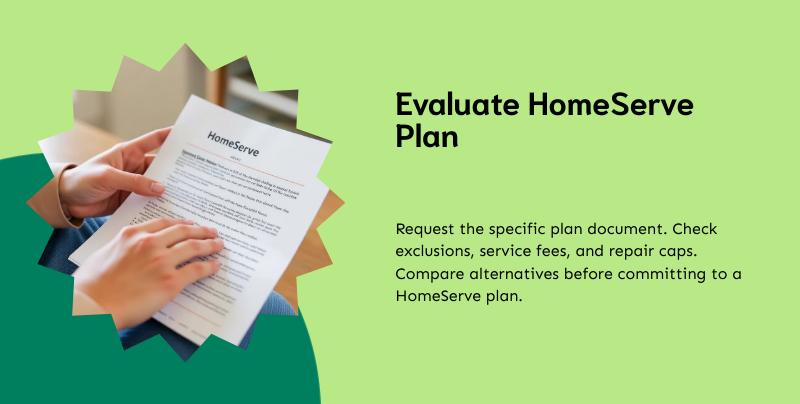
How to Evaluate (and Choose) a HomeServe Plan in Your Market
If you’re interested in HomeServe, here’s a step-by-step evaluation methodology to reduce unpleasant surprises:
- Request your specific plan document — not just a marketing summary.
- Read “what’s excluded” carefully — that’s where many complaints come from.
- Ask about service fees / deductibles — how much will you pay on each call?
- Check repair caps — what’s the maximum payout per repair and annually?
- Inquire about contractor selection — will they allow choice or require their network?
- Confirm waiting periods — is there a grace period before coverage starts?
- Get reference or reviews in your ZIP code — contractor responsiveness often varies regionally.
- Ask cancellation and refund policy — how easy is it to terminate and get prorated refund?
- Estimate your risk of repairs — consider the age of your home systems and your area’s history.
- Compare alternatives — local warranties, home warranty companies, or pay-as-you-go repair funds.
This diligence can help you avoid surprises or coverage gaps later.
Deep Dive: What HomeServe Covers (and What It Doesn’t)
HomeServe’s catalog spans exterior service lines (water, sewer/septic), interior plumbing and drainage, electrical, and selected HVAC/appliance options. Coverage is plan-specific and varies by ZIP code, so the safest way to evaluate fit is to check your local agreement first. For example, the Exterior Water Service Line plan focuses on repairs to the private portion of the water line between your home and the utility connection; it’s not a blanket “anything water-related” policy.
Similarly, Exterior Sewer/Septic Line plans typically define the covered segment as the line running from the exterior wall of your residence to the point where municipal or utility responsibility begins. Terms spell out what counts as a covered failure (e.g., leaks, breaks, clogs) and where coverage ends. If the failure involves a portion of the system deemed the utility’s responsibility—or an excluded cause—claims can be denied. Always read the definitions page in your agreement.
Interior plumbing and drainage plans can bundle in-home drain lines and fixtures, but exclusions such as pre-existing conditions, inadequate maintenance, or improper installation commonly appear in the fine print, along with waiting periods before the first claim. This is standard for service-contract style products but easy to overlook if you only read marketing pages.
Limits, Caps, Fees, and Waiting Periods: The “Math” That Matters
A recurring friction point in customer reviews across the industry is mismatched expectations around caps (per-repair and annual), service call fees, and what counts toward limits (labor, materials, permits, restoration). HomeServe’s plan pages call out highlights, while the actual Service Agreements enumerate coverage caps and conditions. Before enrolling, request the latest agreement PDF for your address and confirm: (1) dollar limits per incident/year, (2) what restoration is included (e.g., backfill, sidewalk/landscape repair), and (3) whether there’s no service fee in your area or a standard charge per dispatch.
Real-world takeaway: If your municipality frequently experiences failing clay or cast-iron sewer laterals, a plan that caps at several thousand dollars per year can still be valuable because even one excavation can exceed DIY budgets. Conversely, if your infrastructure risk is low (newer PVC laterals, shallow lines, stable soils), you may pay more in premiums than you ever recoup.
How Fast Is a Fix? Contractor Networks and Response Reality
HomeServe operates via regional contractor networks. In many Trustpilot entries, customers report same-day or next-day dispatch and courteous technicians—especially for straightforward plumbing calls. But others cite no-shows, reschedules, or slow triage during peak seasons. That variability is typical for any national dispatch model and underscores why your experience will hinge on who serves your ZIP code.
BBB data shows a high volume of complaints over the last three years (common for large plan providers), with patterns around delays, denials, and billing. High complaint counts don’t automatically mean poor performance—scale and product category matter—but they do signal you should check local reviews and ask how many licensed providers cover your area and response SLAs during peak loads.
Utility Partnerships: Why Your City Keeps Mailing You Offers
One reason you see HomeServe (and its Service Line Warranties of America arm) so often is their long-running partnerships with municipalities and utilities—sometimes co-branded with the National League of Cities. The pitch: aging water/sewer infrastructure exposes homeowners to big out-of-pocket lateral repairs; a low-cost plan smooths that risk. Cities often re-introduce the program seasonally or after weather events that correlate with breakages. If your city is an active partner, contractor availability and program awareness are typically better—though you should still vet your local network.

Claims Experience: How to Raise Your Approval Odds
To reduce friction and speed approvals:
- File through the app/portal quickly and document the symptom timeline (photos/video if possible).
- Keep maintenance proof (clean-out installs, periodic rodding, water-pressure records) if your plan requires “proper maintenance”—it helps counter pre-existing/neglect denials.
- Confirm symptom cause with the contractor—e.g., tree-root intrusion in your private lateral vs. main line issues (utility responsibility).
- Know your caps before authorizing extras; ask whether concrete/landscape restoration is part of the covered scope or a separate charge.
Cancellation, Billing, and Fine-Print Hygiene
A non-trivial share of BBB complaints concerns cancellation and billing—continued charges after a homeowner thought they’d canceled, or disputes over refunds mid-term. Before enrolling, ask support to email the exact cancellation terms, any early-termination conditions, and the process (phone vs. portal). If you enroll through a utility-bill add-on, clarify whether cancellation flows through the utility or HomeServe. Keep dated emails and call logs.

When HomeServe Beats a DIY Emergency Fund (and When It Doesn’t)
HomeServe can win when your expected loss is lumpy and expensive (e.g., a 60-year-old clay sewer lateral under a driveway). One claim can justify years of premiums if plan caps meaningfully offset excavation, replacement, and restoration. It’s also useful if you’re time-poor—the dispatch/coordination service has value during emergencies.
A DIY fund can win if your infrastructure risk is low, you prefer choosing contractors, and you’re comfortable with occasional large outlays. Younger neighborhoods with PVC laterals and shallow depths often favor saving the premium in a dedicated reserve. The tie-breaker is often local data: ask neighbors or your city water department about breakage rates and common failure modes.
Alternatives and Comparison Angles (Quick Matrix)
If you’re still deciding, stack HomeServe against two common alternatives:
| Option | Strengths | Watch-outs | Best For |
| HomeServe/SLWA plan | Lower monthly cost; targeted line/system coverage; utility familiarity | Caps, exclusions, contractor variance | Older infrastructure; homeowners wanting predictable costs |
| Traditional home warranty | Broad system/appliance coverage | Higher monthly cost; service fees; variable claim approvals | Owners seeking whole-home safety net |
| DIY emergency fund | Full control of contractor/scope; no caps | Requires discipline; one big repair can wipe fund | Low-risk homes; savvy DIYers |
Reputation Snapshot: What Recent Reviews Indicate
Recent Trustpilot entries skew positive for prompt plumbing/electrical dispatches and technician professionalism, though there are clear outliers citing scheduling snags or communication gaps (especially around first-tier call handling). On the BBB side, the complaint volume is notable for a company with a national footprint—helpful as a caution to verify local contractor density and confirm claim criteria in writing. Neither data point is dispositive on its own; taken together, they support a “proceed, but verify locally” stance.
Is HomeServe Worth It?
Deciding whether HomeServe is the right choice ultimately comes down to your home’s condition, your financial comfort level with risk, and the reliability of contractors in your area. After analyzing every major component — coverage, pricing, customer service, and plan flexibility — the verdict is clear: HomeServe can be an excellent value for the right homeowner, but it’s not a one-size-fits-all solution.
HomeServe’s greatest strengths lie in its affordability and convenience. The company’s targeted coverage for plumbing, water and sewer lines, electrical systems, and HVAC components fills a critical gap that traditional home warranties often overlook. For homeowners in older neighborhoods or regions prone to infrastructure issues, these plans can prevent large, unexpected repair bills. The partnerships HomeServe maintains with cities and utilities also provide an added layer of trust and accessibility, which few competitors can match.
Still, consumers should approach enrollment with informed caution. The company’s coverage caps, exclusions, and contractor network quality can vary widely depending on location. Some customers experience fast, professional service and complete repairs, while others report delays or disputes over what qualifies for coverage. The best protection against disappointment is due diligence: review your exact plan document, verify local contractor availability, and confirm limits and deductibles before signing up.
If you’re a homeowner with aging plumbing or electrical systems, or if you simply prefer predictable repair costs, HomeServe’s plans can provide peace of mind at a fair monthly price. On the other hand, those living in newer homes with modern infrastructure may find that the annual cost outweighs the likelihood of needing significant repairs, making a self-funded emergency reserve a better choice.
The post HomeServe Review: Everything You Need to Know by Benzinga Sponsored appeared first on Benzinga. Visit Benzinga to get more great content like this.
[ad_2]
Source link